

Why the $3 Bin Is Often the Best Part of the Store
The expensive wall tells you what collectors value. The $3 bin lets you find out what you’re curious about. And sometimes that’s a lot more fun.
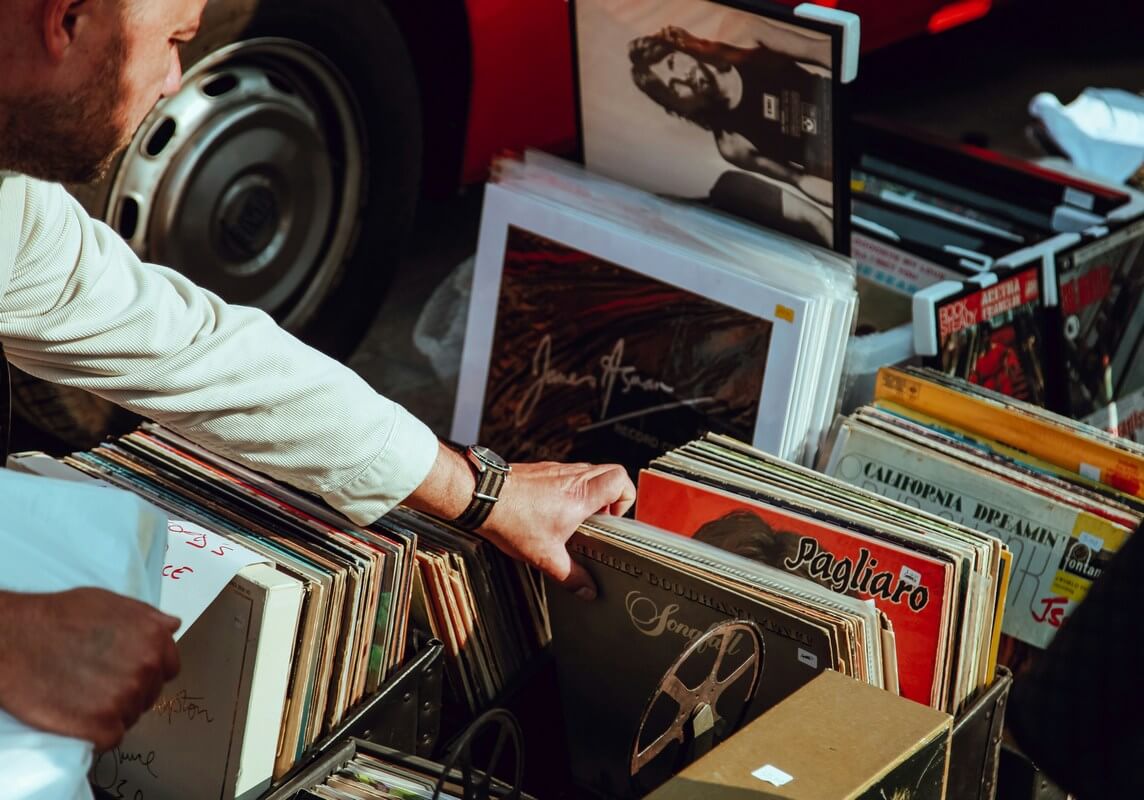
I'm standing in a record store with a new reissue in my hand.
It's $35.
I know the album. I like the album. There is a very real possibility I already own another version of it somewhere, although naturally I am choosing not to investigate that question too closely.
Then I look down.
Under the main racks is a battered crate with a handwritten sign:
$3 EACH
Now we're talking.
Inside is a CD I forgot existed, an LP by an artist I recognize but have never actually heard, an inexplicable movie soundtrack, several compilations, something with a cover so weird I need to know more, and a cassette that appears to have traveled here directly from 1989.
Twenty minutes later, the $35 reissue is back on the shelf.
I am carrying six things I had absolutely no intention of buying when I walked in.
This is why I love the cheap bins.
Depending on the store, it might be the $1 bin, the $2 rack, the $5-and-under section, the clearance shelf, a milk crate on the floor, three cardboard boxes under a table, or a stack of CDs near the register that appears to be organized according to principles unavailable to modern science.
The price isn't really the point.
The point is that the stakes are low enough for curiosity to win.
Three Dollars Changes the Question
At $30 or $40, I think about a purchase.
Do I really want this album?
Is this the version I want?
Will I play it enough?
Do I already own it?
At $3, my internal review process becomes considerably less rigorous.
Do I remember one song?
Have I always wondered about this artist?
Wait, that person produced this?
Why is everyone on the cover dressed like that?
Is this soundtrack completely ridiculous?
Could this be terrible?
For three dollars, do I care?
That difference matters.
Cheap physical music creates room for experimentation. It gives me permission to wander outside the albums I already know I like and the artists some recommendation system has correctly determined belong in my general musical neighborhood.
Sometimes I want accuracy.
Sometimes I want chaos.
The bargain bin is extremely good at chaos.
Discovery Without an Algorithm
I use streaming constantly, and I have no interest in pretending its recommendation systems aren't useful. They are remarkably good at putting music in front of me based on what I've already played.
But that's a particular kind of discovery.
A streaming service knows what I listened to yesterday. It knows what I skipped. It knows which artists overlap with the ones I already like. It knows which playlists I use and what millions of vaguely similar listeners are doing.
The $3 bin knows absolutely nothing about me.
It contains whatever happens to be there.
Maybe somebody sold a collection.
Maybe a title has been sitting around too long.
Maybe the store has seventeen copies.
Maybe the jacket isn't pretty enough for the main rack.
Maybe nobody in town currently cares about 1987 smooth jazz.
Maybe somebody finally decided the world did not require quite this many copies of a particular movie soundtrack.
It is a terrible recommendation engine.
Which is exactly why I like it.
One system predicts.
The other surprises.
I have room for both.
Digging Is Different From Searching
There is a fundamental difference between finding the album I searched for and finding an album I didn't know existed.
Searching is fantastic when I know what I want.
Digging is better when I don't.
That's how I end up staring at things I never would have typed into a search bar: forgotten major-label releases, obscure side projects, solo albums, local bands, strange compilations, budget-label collections, dance singles, old country records, gospel, classical albums, comedy records, imports, soundtracks, promotional discs and exceptionally specific instructional recordings that raise more questions than they answer.
Some of them will be bad.
That's okay.
One of the great freedoms of the cheap bin is that every experiment does not have to uncover a hidden masterpiece.
Sometimes I buy a $3 album, play it once and discover that the previous owner and I had very different ideas about what constitutes a good time.
That is useful information.
The Cover Buy Is Still Alive
I absolutely buy physical music because of the cover.
This is not rational behavior.
I have made peace with it.
A record, CD or cassette can give me a surprising amount of information before I hear a note. I can look at the artwork, typography, musicians, song titles, label, producer, release year, photographs, liner notes and general visual evidence of whatever was happening culturally when somebody approved this package.
Sometimes one familiar name is enough.
I recognize the producer.
I know one of the musicians.
I've seen the label before.
The songwriter worked with somebody I like.
Or maybe none of that applies and the artwork is simply strange enough that I need answers.
At $35, interesting typography does not usually close the sale.
At $3, it has a fighting chance.
This strategy has produced pleasant surprises.
It has also produced complete disasters.
Both outcomes seem fair.
The One-Song Album
Another favorite category: I know one song.
You know the situation.
The title catches my eye, I look at the track list, and suddenly I remember the hit. Maybe I haven't heard it in fifteen years. Maybe I loved it. Maybe I tolerated it because radio stations once played it every 43 minutes.
Either way, I know that song.
At new-vinyl prices, that may not be enough to buy the whole album.
For a $3 CD?
Sure.
And this is where things get interesting.
Sometimes the hit really was the best song.
Sometimes the rest of the album is better.
Sometimes I rediscover an artist I'd mentally reduced to one single.
Sometimes I understand why everybody seemed to own the album in 1996.
And sometimes I finish it and think, yes, humanity correctly selected the one song.
Again, three dollars.
Common Doesn't Mean Bad
Cheap bins are full of albums that sold extremely well.
That isn't a contradiction. It's often the reason they're cheap.
Millions of copies of popular albums were manufactured. Decades later, a lot of those copies are still out there circulating through record stores, thrift shops, estate sales, garage sales and people's basements.
An album can be culturally important, musically excellent and ridiculously common at the same time.
Collector scarcity and musical quality have never been the same thing.
In fact, some great music stays inexpensive precisely because an enormous number of people bought it.
This is worth remembering when collecting culture starts treating scarcity as a synonym for importance.
Price tells me something about the market for that particular copy.
It does not tell me how much I will enjoy listening to it.
CDs Might Be the Bargain-Bin Superpower
If I had to nominate one format for the current cheap-music championship, CDs would make a strong case.
For years, people unloaded them by the box. Used stores, thrift shops, library sales and charity shops ended up with enormous inventories, and plenty of excellent albums still sell for only a few dollars.
Meanwhile, CDs are becoming interesting to buyers again.
In the first half of 2026, U.S. CD sales rose 16 percent year over year to 16.3 million units, according to Luminate. K-pop contributed heavily to that increase, but Luminate says sales were still up 6.7 percent even with K-pop removed. Vinyl still sold more units during the same period, at 21.8 million, but the CD growth is real.
None of that means your local thrift store is about to turn its $2 CD rack into Fort Knox.
At least I hope not.
Used CDs remain one of the easiest ways to build a substantial physical music collection without needing to establish a separate line item in the household budget called things I found in a bin.
You get a complete album. Often the booklet. Sometimes bonus tracks. Sometimes an edition that differs from whatever is currently on streaming.
And you can carry six of them without developing a new structural concern in your bookshelf.
CDs also reproduce standard digital audio directly from the disc. I don't need to turn that into an argument about whether CDs are spiritually superior to streaming. They aren't required to win a format war.
A $3 CD only has to contain music I want.
That's enough.
Give the Used CD Ten Seconds
I do check used CDs before buying them.
I look for obvious scratches, especially deeper damage. I check the label side. I make sure the correct disc is actually inside the case, because humanity has demonstrated repeatedly that this cannot be assumed.
I check whether the booklet is present if I care about it.
Cracked jewel case?
I barely register it.
Jewel cases can be replaced. They seem to regard broken hinges as part of their natural life cycle anyway.
The Library of Congress recommends handling optical discs by the outer edge and center hole, and preservation guidance notes that scratches, smudges and dirt can interfere with playback. So yes, condition matters. But fingerprints are not an emergency.
We've got a full guide to CD care and storage for the deeper stuff. In the store, I'm mostly trying to determine whether I've found a cheap album or a decorative coaster.
Cheap Vinyl Doesn't Mean Bad Vinyl
Vinyl bargain bins require a slightly different eye.
A record may be inexpensive because the pressing is common, the jacket has wear, the artist has fallen out of fashion, the genre isn't currently hot, the record is a compilation, the copy is a later pressing or the store simply has too many of them.
Condition can obviously matter more.
But cheap still does not automatically mean bad.
One record store may carefully grade and clean used inventory before it reaches the floor. Another may have a cardboard box containing things that appear to have survived both a basement flood and a small regional conflict.
This is part of the adventure.
Stores themselves make buying decisions based partly on what they believe they can sell. Condition, genre, demand and the amount of similar inventory already sitting on the shelves all matter.
The bargain bin is not necessarily where bad music goes.
Sometimes it is simply where less commercially desirable copies go.
Those are very different things.
Dirty and Damaged Are Not the Same
My basic used-vinyl rule is simple:
Know the difference between dirty and damaged.
Dust can be cleaned.
Fingerprints can be cleaned.
A filthy record may improve dramatically after proper cleaning.
A deep scratch is still a deep scratch.
A serious warp is still a warp.
Damage doesn't disappear because I believe in it.
I'm willing to tolerate cosmetic imperfections at bargain prices.
I'm less interested in buying a record that resembles topographical evidence of tectonic activity.
If you want the full version, our guide to caring for vinyl records without losing your mind covers cleaning, handling, sleeves, storage, and the things that actually matter.
Cassettes: Apparently We're Doing This Again
Records came back.
CDs are being rediscovered.
And cassettes, which spent several decades demonstrating an impressive ability to become tangled inside car stereos, have somehow received another invitation.
Fine.
Welcome back.
Cassette sales are still tiny compared with vinyl and CDs, but renewed interest in them is measurable.
Tapes also remain interesting at the cheap end of the used market because you can find albums from the era when cassette was a dominant format, local releases, demos, promotional material and small-label oddities.
The packaging is compact. The format has history. Independent artists still release music on it.
And sometimes I simply enjoy finding an album in the format I actually owned when the album was new.
I do inspect tapes more carefully than I once did.
Mold is a hard no.
I look at the shell, exposed tape and case. I check whether the tape appears damaged or stretched. If the design uses a pressure pad, I want it to still exist.
That is enough cassette-care advice for today.
Nobody came here for a dissertation on pressure pads.
Compilations Deserve More Respect
Bargain bins are compilation headquarters.
Greatest hits.
Label samplers.
Dance collections.
Classical boxes.
Movie soundtracks.
Budget releases.
Tribute albums.
Promotional samplers.
TV-advertised collections with cover art that suggests the graphic designer had eleven minutes before lunch.
Collectors sometimes dismiss compilations because they aren't the "real" album.
I don't.
A good compilation can be an excellent introduction to a genre or artist. It can capture a particular moment in music. It can lead me toward five albums I didn't know I wanted.
And yes, some compilations are spectacularly bad.
That's also informative.
Soundtracks Are Tiny Time Machines
Soundtracks deserve their own corner of bargain-bin affection.
Years after the movie has stopped being culturally urgent, the soundtrack may still be sitting there.
And the track listing can be fascinating.
A soundtrack can combine artists that would never otherwise share shelf space. It may contain a remix, alternate version or track that isn't easy to find elsewhere. Even when nothing is exclusive, the sequencing can capture an incredibly specific moment in music.
Sometimes I pick one up and immediately remember the era.
Sometimes I have never seen the movie.
That has never stopped me.
Local Music May Be the Most Interesting Find
One of my favorite cheap-bin possibilities is the release I know nothing about.
A self-released CD.
A cassette from a local band.
A tiny regional label.
A demo.
A promotional release from a group that played clubs twenty-five years ago.
These items do not automatically have monetary value.
They may not even be good.
But they can be interesting in a way another readily available copy of a famous album isn't.
A local CD from 1998 might have almost no online footprint. The band may have disappeared. The club listed in the thank-you notes may be gone. The website on the back may point toward a domain currently selling industrial plumbing equipment.
But the music still exists.
Physical releases can preserve little corners of music culture that were never comprehensively transferred into the streaming world.
Not every bargain bin is secretly an archive.
Occasionally, though, it behaves like one.
Music the Internet Doesn't Present Neatly
Streaming catalogs are enormous.
They are not complete.
Licensing changes. Regional availability differs. Releases are remastered. Track lists change. Certain editions disappear. Some independent or regional releases were never uploaded in the first place.
That does not mean the average thrift-store shelf is overflowing with lost media.
It isn't.
But physical digging occasionally produces a version of something that the current digital catalog does not present in quite the same way.
Maybe it has a bonus track.
Maybe it uses an earlier master.
Maybe it's a compilation that vanished.
Maybe it is a local release that never made the jump.
Ownership becomes useful here in the simplest possible sense:
The copy on my shelf does not need another licensing agreement in order to remain on my shelf.
Every Hunting Ground Has Its Own Personality
Dedicated record stores are usually the easiest.
The inventory is more likely to be organized, someone has usually looked at the condition, and the pricing tends to reflect at least some knowledge of what is being sold.
Then there are thrift stores.
Goodwill.
Charity shops.
Absolute chaos.
Sometimes the CD section is magnificent.
Sometimes it appears to consist entirely of Christmas albums, instructional software and the same Josh Groban release six times.
Library sales can be particularly good for CDs. Depending on the library and what has been donated or withdrawn, you may run into jazz, classical, world music, unusual compilations and older catalog titles that would never have crossed your mind otherwise.
Garage sales are completely unpredictable.
You are basically opening a cardboard box containing one person's musical life.
Sometimes everything is three for a dollar.
Sometimes the seller has one Beatles record with no sleeve and has somehow concluded that Sotheby's should have been contacted.
Estate sales can be fascinating because you occasionally see an entire musical personality intact: jazz, country, classical, rock, opera, whatever someone spent decades collecting.
The downside is that storage conditions matter. Basements and garages are not noted for their archival standards.
Flea markets and record fairs land somewhere between random and professional. You may find experienced dealers five tables away from someone selling a box of records discovered behind a washing machine.
I enjoy all of it.
Someone Owned This Before Me
Used music occasionally comes with evidence.
A name written inside the jacket.
An old store sticker.
A radio-station mark.
A library stamp.
A handwritten cassette label.
A receipt tucked into the booklet.
A tiny note nobody remembered was there.
I don't need every used object to carry a sweeping human narrative. Sometimes somebody wrote "STEVE" on a record because Steve was tired of his roommate stealing it.
Still, I like these little traces.
A used object had a life before it got to me.
The old price stickers are particularly good.
There is something deeply satisfying about buying a CD for $2.99 and discovering that somebody paid $16.99 for it in 1997.
That sticker is basically a miniature economics documentary.
The “It's Only Three Bucks” Problem
Cheap bins do create one significant problem.
They make rationalization extremely easy.
One album:
"It's only $3."
Sixteen albums later:
Apparently I have discovered a new branch of mathematics where three dollars multiplied by sixteen does not equal forty-eight dollars.
There is also shelf space.
And duplicate buying.
And the realization that I have purchased something because it was inexpensive rather than because I actually wanted it.
A bargain isn't useful if I don't care about the thing.
So I have one question that saves me from at least some bad decisions:
Can I imagine myself actually playing this?
Not:
Could it become valuable?
Not:
Would somebody on the internet approve?
Not:
Should a serious collector own it?
Will I play it?
That's enough.
Check the Collection Before Buying It Again
Cheap-bin enthusiasm also causes amnesia.
I will stand there holding an album thinking:
I'm pretty sure I don't own this.
Which is collector language for:
There is at least a 40 percent chance I own this.
Different artwork makes it worse.
Different formats make it worse.
A later CD edition looks different.
A reissue has a different cover.
Or I am simply absolutely certain I would remember buying it.
I may not.
This is one reason having a searchable catalog on my phone is useful. I can check my collection while I'm standing in the store instead of conducting a much less reliable database query against my own brain.
RecordRoom was built for exactly that sort of moment: find the album, check whether it's already in the stack, and avoid bringing home your third accidental copy unless you genuinely want three.
No judgment if you do.
Mix the Formats
One of the easiest ways to make physical collecting affordable is to stop treating one format as mandatory.
Maybe the new LP is $35.
The used CD is $4.
If my goal is owning and listening to the album, the CD may be the obvious choice.
Another album might be inexpensive on vinyl.
Maybe the cassette is interesting because that's how I remember it.
Maybe the CD edition includes bonus tracks.
The music collection does not have to obey a format hierarchy.
Vinyl remains a major part of the physical music market, but CDs continue to sell in significant numbers and cassettes have carved out their own much smaller corner.
Physical music isn't a one-format category.
That is good news for people who care more about music than winning imaginary format arguments.
You Are Allowed to Buy Something Uncool
The bargain bin is wonderfully indifferent to taste hierarchies.
It contains albums that are unfashionable.
Albums from the wrong decade.
Albums critics forgot.
Albums that were once so popular that everybody owned one.
Albums associated with genres currently receiving approximately zero cultural prestige.
Great.
Nobody is grading the shelf.
Buy the album.
Physical music collecting gets much less interesting when every collection starts looking like the same list of 100 approved classics.
The weird stuff tells the story.
The soundtrack.
The compilation.
The old country record.
The CD you bought because you knew one song.
The local band.
The cassette you cannot adequately explain.
Those choices are what turn an inventory into your collection.
Pass Along the Experiments That Don't Work
There is no rule saying every album I buy has to live with me forever.
If a $3 experiment fails, I can trade it.
Sell it back.
Donate it.
Give it to somebody who will appreciate it.
Put it into a record swap.
Physical music circulates.
That circulation is the entire reason used record stores have anything for us to dig through.
A collection should not become a permanent prison for every purchasing decision I've made since adolescence.
Editing is allowed.
It also creates shelf space, which I will immediately misuse.
My Bargain-Bin Rules
Over time I've developed a few loose rules.
Start with curiosity. If something makes me stop, I give it a second look.
Check the condition. Three dollars is still too much for something unplayable.
Read the credits. Producers, musicians, songwriters, labels and studios can send me down interesting paths.
Don't dismiss common albums. Common often means lots of people bought them for a reason.
Take occasional chances. The whole point is discovering something I wasn't already planning to buy.
Don't buy something solely because it's cheap. That way lies shelving problems.
Mix formats. I want the music. Vinyl, CD and cassette are all allowed to solve that problem.
Ask whether I'll actually play it. That question eliminates a surprising amount of nonsense.
None of these rules are strict.
It's a three-dollar bin, not an IRS audit.
The Best Jackpot Isn't Financial
Every bargain-bin dig contains the fantasy.
I find something cheap.
I vaguely recognize the artist. Maybe I like the cover. Maybe somebody behind the counter says, "If you're buying that, just take this too."
I bring it home.
I play it.
And it is fantastic.
Not "fantastic because I discovered somebody will pay $600 for it."
Just fantastic.
I keep playing it.
Then I start looking for another album by the same artist.
That leads to another musician.
Another label.
Another genre.
Six months later, one random $3 purchase has opened an entire branch of music I wasn't exploring before.
That is the jackpot.
I discovered music.
Everything else is accounting.
And That's Why I Keep Looking
So eventually I make my way to the register.
Maybe I have two CDs.
One slightly worn LP.
A compilation.
A soundtrack I cannot defend.
And, against all available evidence that this is a practical decision, a cassette.
None of them is rare.
None is an investment.
I may not even love all of them.
But somewhere in that little pile could be the album I play repeatedly for the next month.
And even if there isn't, I spent an afternoon looking at music I didn't know I was looking for.
That's why I keep checking the boxes on the floor.
The expensive wall tells me what the market currently considers valuable.
The $3 bin asks a much more interesting question:
What are you curious about?
Photo by [Clem Onojeghuo](https://unsplash.com/@clemono?utm_source=unsplash&utm_medium=referral&utm_content=creditCopyText) on [Unsplash](https://unsplash.com/photos/person-holding-vinyl-records-pTeZKi29EYE?utm_source=unsplash&utm_medium=referral&utm_content=creditCopyText).